How to Store Copper Cookware Without Damage
The Short Answer
Store copper cookware completely clean and dry, with its lining inspected and each pan protected from hard contact. Hanging is ideal when the rack and mounting can safely carry the loaded weight. In a cabinet, stack only with clean felt, cotton, or purpose-made pan protectors between every piece; place lids separately or padded. Keep copper away from persistent damp, household chemical fumes, and abrasive shelf liners.
Storage will not stop normal tarnish, nor does it need to. The goal is to prevent dents, scratches, trapped moisture, handle strain, and unnoticed lining damage—not to freeze a working pan at its unboxing color.
Do This Before the Pan Goes Away
Wash and Dry It Completely
Remove food and grease with the method appropriate to the lining. Hand-wash tin gently with warm soapy water and a soft sponge. Use nonabrasive care for stainless-lined copper according to its maker. Dry the body, rim, rivets, handle joint, lid lip, and any rolled edges immediately.
Mauviel’s current care FAQ tells owners of several copper-exterior lines to hand-wash with warm soapy water and dry promptly. That is brand-specific guidance for the lines named on the page; it also captures the storage principle well. Do not put a damp lid on a damp pan and call the cupboard a drying rack.
If you polish, remove every residue before storage. Polish trapped around rivets and seams can harden into a pale or greenish crust. Our full copper cookware care guide separates ordinary washing, exterior polishing, and lining-safe cleanup.
Inspect the Cooking Surface
Good storage begins with deciding whether the pan should return to cooking duty at all.
- Tin lining: If copper shows through or copper-colored specks appear, stop cooking with the pan and arrange professional re-tinning. Do not soften that rule because the exposed patch seems small.
- Stainless lining: Look for separation, severe distortion, cracks, or damage that exposes an underlying layer. Surface scratches are not the same as delamination, but uncertainty deserves maker or professional inspection.
- Unlined copper: Do not use it for acidic foods. Unlined pieces belong only to the specific food tasks their maker approves; otherwise keep them decorative.
- Any green or blue-green corrosion: Verdigris is not food-safe. Remove the pan from use until it has been properly assessed and cleaned.
For tin-lined pans, never heat the pan empty. Tin begins to soften and melt around 450°F/230°C, so storage is a good moment to leave yourself a visible reminder if several people use the kitchen. Our tin versus stainless lining guide explains the different care obligations.
Best Storage Methods Compared
| Method | Best for | Main advantage | Main risk to control |
|---|---|---|---|
| Wall or ceiling rack | Frequently used heavy pans | No pan-to-pan contact | Mounting, hook shape, head clearance |
| Pegboard or rail | Smaller pans and lids | Flexible layout | Hardware load and handle crowding |
| Padded cabinet stacking | Limited wall space | Uses existing storage | Scratches, rim pressure, trapped grit |
| Deep drawer with dividers | Small collections | Easy access and visibility | Drawer load and sliding |
| Vertical lid rack | Flat and domed lids | Prevents unstable lid piles | Knob pressure and metal-on-metal slots |
| Open shelf, unstacked | Display pieces used often | Easy inspection | Dust, grease film, edge falls |
No method is universally best. Choose the one that protects the heaviest pan, not the one that photographs best before cookware is added.
Hanging Copper Pans Safely
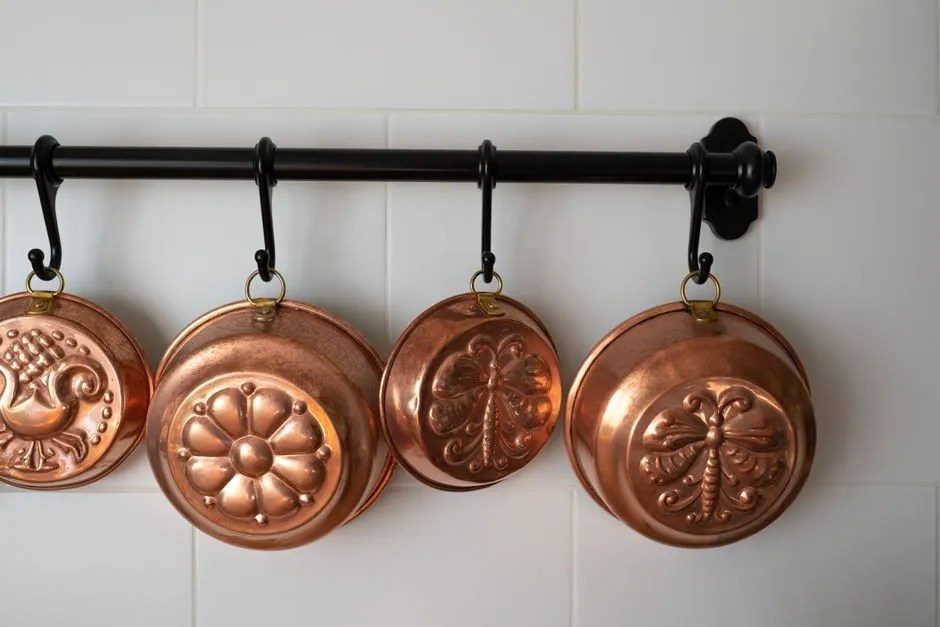
Hanging keeps surfaces apart and turns a working collection into useful display. It also concentrates significant weight above people and counters, so the structure matters more than the copper.
Confirm the Support
Mount racks, rails, and hooks into framing or another support system rated for the total installed load. Include the rack, every pan, lids, hooks, and a safety margin. Drywall alone is not a plan. When the framing, fastener, ceiling construction, or electrical runs are uncertain, use a qualified installer.
The cookware maker’s weights and the hardware maker’s installed load rating are the figures that matter. Do not guess from pan diameter, and do not add individual hook ratings as if the rail or ceiling attachment has unlimited capacity.
Use Hooks That Fit the Handles
The hook should sit securely through the handle opening without forcing, pinching, or placing all pressure on a thin decorative edge. Avoid unfinished hooks with burrs. Coated or smoothly finished hooks reduce scraping, but inspect coatings for wear.
Hang the heaviest and most-used pans where they can be lifted with two hands and without reaching over a hot burner. Keep lids and long handles from swinging into one another. A tower of copper is lovely until it auditions for percussion whenever a cabinet closes.
Leave Air and Hand Space
Allow enough space to lift one piece without levering against its neighbor. Do not hang a lid behind a pan if removing either scrapes the other. Keep cookware away from the direct path of cooking steam and aerosolized grease; an open rack beside the range may require more frequent washing than a cabinet.
How to Stack Copper Without Scratching It
Stacking is safe when every contact point is padded and the pile remains modest.
- Clean the shelf and every pan. A single grain of salt or grit can scratch under pressure.
- Put the largest, most stable pan at the bottom.
- Add a clean, dry, nonabrasive protector large enough to cover the base and rim contact points.
- Nest the next pan gently; do not force handles into alignment.
- Stop before the stack becomes difficult to lift without dragging.
- Store heavy lids separately rather than balancing them on linings.
Felt and purpose-made pan protectors work well when clean and dry. Washable cotton cloths are fine if they do not shed grit, hold moisture, or contain metal fasteners. Avoid printed newspaper, rough paper, abrasive mesh, and foam that is crumbling, sticky, or chemically odorous.
Never rest a smaller pan directly on a tin lining. Tin is soft; a base ring, rivet, or rough spot can leave a permanent track. Stainless is tougher, but copper exteriors and polished rims still mark when hard surfaces slide.
Store Lids as Their Own Category
Lids cause a surprising share of storage damage because knobs create pressure points and rims behave like metal scribes.
Use a vertical rack with padded or smooth slots, a shallow drawer with dividers, or individual shelf positions. If a lid must sit upside down on its pan, place a protector between the lid and lining and confirm that the knob does not bear the weight of another pan.
Do not seal a lid tightly on a pan that is even slightly damp. Leave airflow until both are unquestionably dry. Cast-iron handles and dissimilar metals around rivets may need their own care; follow the maker rather than applying copper polish indiscriminately.
Preventing Tarnish Without Damaging the Pan
Copper tarnishes when it reacts with its environment. Indoor humidity, sulfur-containing compounds, fingerprints, cooking residue, and airborne grime can affect the surface. Normal brown patina is cosmetic on an exterior; verdigris is a different matter and must not remain on food-contact equipment.
For cookware used regularly:
- dry it promptly;
- store it away from chronic damp and leaks;
- keep household cleaners, pool chemicals, and strong chemical fumes elsewhere;
- handle polished display surfaces with clean dry hands;
- cover rarely used pieces with breathable, clean protection rather than sealing in moisture.
Do not wrap a possibly damp pan tightly in plastic. Do not place unknown anti-tarnish paper or chemical strips against a food-contact lining unless the maker says that exact product is appropriate.
The Canadian Conservation Institute’s copper-care note makes an important distinction: polishing is abrasive and repeated polishing removes surface detail. Museum care is not kitchen care, but the physics carries over. Polish when you want shine, with a cookware-appropriate product and method; do not make aggressive polishing a storage ritual.
Long-Term and Seasonal Storage
For a pan that will sit for months:
- Photograph its exterior, lining, rim, handle, and marks.
- Record existing scratches, dents, lining wear, and repairs.
- Clean and dry it fully.
- Wrap it loosely in clean, soft, nonabrasive material.
- Support the whole body on a stable shelf, not by a handle under constant leverage.
- Keep it off floors and away from exterior walls prone to condensation.
- Inspect periodically for damp, pests, corrosion, or material breakdown.
For vintage copper with uncertain lining or repairs, label it clearly as “not cleared for cooking” until a knowledgeable professional assesses it. Our guide to buying vintage copper cookware covers the clues that storage alone cannot settle.
What Not to Do
- Do not stack copper directly against copper, steel, cast iron, or rough ceramic.
- Do not hang from loose rivets, cracked handles, makeshift wire, or unrated fittings.
- Do not store food in copper cookware.
- Do not leave a pan wet under a lid or inside a plastic bag.
- Do not use a worn tin lining because “the exposed copper is only a speck.” Stop cooking and seek re-tinning.
- Do not polish verdigris and then assume the cause is solved; persistent corrosion needs assessment.
- Do not use furniture wax, decorative lacquer, or conservation chemicals on cooking surfaces.
The Bottom Line
Clean, dry, inspect, separate, and support. Hang copper only from properly installed hardware; stack it only with clean full-coverage padding; store lids so their rims and knobs cannot press into linings. Accept ordinary exterior patina if you like it, but never accept exposed copper through tin, verdigris on food-contact equipment, or damp trapped in storage. A good system makes the next pan easy to reach and every problem easy to see.