Hammered vs. Smooth Copper: Does the Finish Change How It Cooks?
The Short Answer: Hammering Is Mostly About Looks
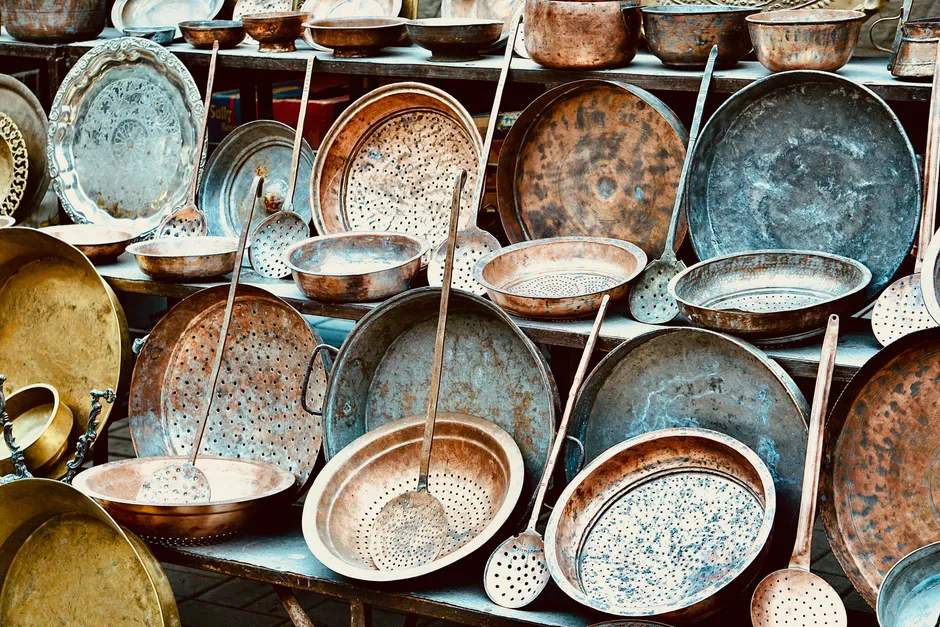
Walk past a wall of copper pans and the hammered ones grab you first — thousands of small facets catching light like a disco ball made respectable. The question is whether all that texture does anything on the stove. Here's the honest verdict, up front:
Hammering does not meaningfully change how a copper pan cooks. Heat conduction is governed by the copper itself — its thickness, its purity, and its lining — not by the surface texture on the outside. A 2.5mm smooth pan and a 2.5mm hammered pan from the same maker will perform essentially identically. Claims that hammering "increases surface area for better heat distribution" are marketing physics, not real physics: the dimples are on the exterior, the heat still has to travel through the same wall, and any surface-area effect is negligible at cooking scale.
What hammering did do, historically, was work-harden the metal. Before modern rolling mills, coppersmiths planished (hammered) pans to compress and stiffen relatively soft copper, making a thinner sheet more rigid and dent-resistant. On today's machine-rolled copper — which comes off the mill already dense and uniform — decorative hammering is largely cosmetic, though a lightly hammered surface can still hide small dings and scratches better than a mirror finish.
So the real decision is aesthetic and practical, not thermal. Here's how to make it.
What Actually Determines Cooking Performance
Before comparing finishes, it's worth restating the criteria that genuinely matter — the same framework we use in our full copper cookware buying guide:
- Thickness (gauge). This is the big one. Around 2mm or more of copper delivers the responsiveness people pay for; 2.5mm is the sweet spot for serious pans. Thin 1–1.5mm copper — hammered or smooth — heats fast but unevenly and dents easily.
- Lining. Cooking copper must be lined, full stop. Bare copper is reactive and isn't safe for general cooking, especially with acidic foods like tomato, wine, or citrus. Tin and stainless steel are the two legitimate linings, each with tradeoffs.
- Construction. Solid rivets, a comfortable iron, brass, or stainless handle, and a rolled or well-finished rim. These outlast any finish choice.
- Finish. Hammered or smooth — the tiebreaker, not the headline.
If a seller leads with "hammered" and buries the thickness and lining details, treat that as a yellow flag. Plenty of thin, unlined, display-grade copper gets hammered precisely because the texture photographs beautifully. Our guide to decorative vs. functional copper covers how to tell the difference before money changes hands.
Hammered vs. Smooth at a Glance
| Hammered | Smooth | |
|---|---|---|
| Heat performance | No meaningful difference | No meaningful difference |
| Look | Artisanal, rustic, catches light | Sleek, classic French-kitchen |
| Hides wear | Very well — dings and scratches blend in | Poorly — every scuff shows on a mirror polish |
| Polishing effort | Slightly fiddlier (texture holds tarnish in recesses) | Faster to polish, faster to show tarnish |
| Historical function | Work-hardening (mostly obsolete on modern rolled copper) | The default for most professional French makers |
| Price effect | Sometimes a premium for hand-planished pieces | Usually the baseline |
| Watch out for | Thin decorative pieces dressed up as cookware | Nothing finish-specific |
The Case for Hammered Copper
Why choose it
Choose hammered because you love how it looks — that's a completely legitimate reason to prefer one pan over another, and we'd rather say so plainly than invent a thermal justification.
- It ages gracefully. The faceted surface scatters light, so the inevitable dings, scratches, and patches of dulling patina read as character rather than damage. A hammered pan that's ten years into service usually looks better than a smooth pan with the same mileage.
- Craft heritage is real. Genuinely hand-planished copper — the kind still produced by some traditional workshops, notably in Italy and France — carries visible evidence of handwork. If that matters to you, it's worth paying for.
- It's forgiving in open kitchens. Hanging on a rack, hammered copper stays presentable with less polishing anxiety.
Worth knowing
The honest drawback: the texture complicates polishing, and the "hammered" label is used loosely. Tarnish settles into the recesses, so bringing a hammered pan back to full brightness takes a bit more time with polish and a soft brush than wiping down a smooth surface. More importantly, machine-stamped dimple patterns on thin copper are common in the decor market — the hammering is pressed in, not planished, and signals nothing about quality. And as with any copper you'll cook in: it needs a tin or stainless lining, and if it's tin-lined, remember tin wears with use and melts around 230°C, so never preheat the pan empty or run it screaming hot and dry.
The Case for Smooth Copper
Why choose it
Smooth is the default finish of most serious French cookware houses, and there are practical reasons it stays that way.
- Easier routine cleaning and polishing. A flat exterior wipes down fast, and a lemon-and-salt or commercial-polish session takes minutes with nothing for oxidation to hide in.
- The classic look. If your reference point is a professional French kitchen — rows of gleaming, unadorned sauté pans — smooth is that look. It also pairs more neutrally with modern kitchens where hammered can read busy.
- Widest selection at proper gauge. Because the major performance-focused makers (Mauviel's core lines, Falk Culinair, and similar) mostly produce smooth pans, you'll find the deepest inventory of 2–2.5mm, properly lined cookware in smooth finishes. Our roundup of the best copper cookware sets skews smooth for exactly this reason.
Worth knowing
The honest drawback: a mirror finish shows everything. Fingerprints, water spots, the first heat-tint bloom around the base, every scratch from a careless stack in the cupboard — all of it is visible on smooth copper the moment it happens. If you want a showpiece, budget for regular polishing or make peace early with a soft, even patina (which, for what it's worth, affects appearance only — a tarnished exterior cooks exactly like a bright one).
Special Cases Worth Flagging
- Vintage hammered pans. On genuinely old copper, hammering often was structural — a hand-raised, planished pan from the early 20th century can be excellent cookware. Judge it the same way as any vintage piece: check thickness, check the tin lining for wear-through to bare copper (re-tin before cooking if so), and clean off any verdigris — the green corrosion — completely before the pan touches food.
- Hammered interiors. Rarely, you'll see texture on the inside of a pan or a mixing bowl. For lined cookware this is unusual and mostly harmless; for unlined bowls (like egg-white bowls, which are a legitimate unlined use since whipped whites are brief-contact), it's traditional. Just never confuse an unlined hammered bowl with cooking-safe equipment.
- Hammered mule mugs and barware. Same logic, plus the drink-safety rule: mugs holding acidic cocktails should be lined, hammered or not.
Bottom Line
Buy thickness, buy the right lining, buy solid construction — then let the finish be a pleasure rather than a performance claim. If the hammered pan and the smooth pan on your shortlist are both 2.5mm, both properly lined, and both well made, you cannot pick wrong on cooking grounds. Typical price ranges overlap almost entirely, with hand-planished artisan pieces commanding a premium over machine-finished equivalents; prices vary widely by maker and retailer.
One rule to carry out the door: never let a beautiful hammer finish talk you into thin or unlined copper. The dimples don't cook. The copper underneath does.